May 29, 2026 | Ian Hatcher
Student Reflections Are Powerful. Teachers Need an Easier Way to See Them.
Every day, students are telling us what they understand, what they are curious about, where they feel stuck, and how they are beginning to see their futures differently.
The challenge is not getting students to reflect. The challenge is helping educators see what those reflections reveal.
That is why we built Lesson-Level Reflection Insights.
This new Find Your Grind feature helps teachers quickly understand what students took away from a lesson, where they struggled, and which student voices deserve a closer look—without reading every reflection one by one.
The problem: meaningful student thinking often gets buried
Student reflection is one of the most valuable parts of future readiness learning. It gives students space to make connections, process ideas, and think about who they are becoming. A strong reflection can show growth, confidence, confusion, curiosity, or a shift in perspective.
But teachers are busy. Reading through every reflection for every student after every lesson is not realistic, especially when educators are managing full classrooms, pacing guides, grading, interventions, and everything else the school day demands. So even when students are producing thoughtful responses, that insight can sit unseen.
Teachers may miss signals like:
- A group of students misunderstanding a key concept
- Students connecting a lesson to their personal goals
- A few students showing uncertainty about their next step
- A powerful student response that could spark a class discussion
- Evidence of growth that administrators would want to see
That is the gap Lesson-Level Reflection Insights is designed to close.
What Lesson-Level Reflection Insights do
Lesson-Level Reflection Insights use AI to summarize patterns across student reflections for a specific lesson.
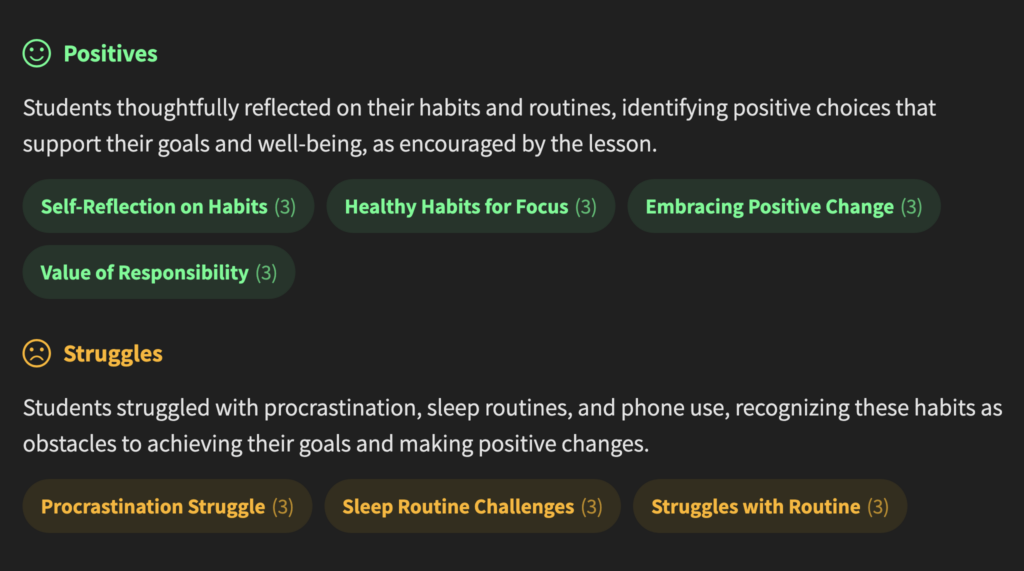
Instead of asking teachers to comb through every response, Find Your Grind highlights the biggest themes in two simple categories:
Positives show where students are demonstrating understanding, confidence, connection, or growth.
Struggles show where students may be confused, uncertain, or in need of more support.
These insights are not grades. They are not automated evaluations. They are instructional signals that help teachers quickly see what is happening across the class.
Teachers can still see the student voice behind the summary
AI summaries are only useful if educators can trust them. That is why Lesson-Level Reflection Insights keep the student voice close to the surface. Teachers can review the evidence behind a theme and see which students contributed to it. They can also see selected student quote highlights when a response clearly shows learning, insight, or struggle.
This matters because reflection is personal. A summary can tell a teacher what is happening across the class. A student quote can show why it matters. Together, they help educators move faster without losing the authenticity of what students actually said.
From reflection data to instructional action
The goal is to help teachers act.
Lesson-Level Reflection Insights can help educators decide when to:
- Revisit a concept students struggled with
- Start a discussion around a common theme
- Recognize strong student thinking
- Follow up with students who may need support
- Understand whether a lesson is connecting with the class
- Share evidence of student growth with school leaders
For teachers, this means less manual review and more useful insight.
For students, it means their reflections are more likely to be seen, understood, and used to shape instruction.
For administrators, it means reflection data becomes a clearer story of student growth, engagement, and future readiness.
Why this matters for future readiness
Future readiness is about helping students understand themselves, explore possibilities, and build confidence in what comes next.
Reflection is where much of that learning becomes visible.
When a student connects a career pathway to their strengths, names a new goal, expresses uncertainty, or explains what they learned about themselves, that is meaningful evidence.
Lesson-Level Reflection Insights help educators see those moments faster.
They turn student reflections into a clearer picture of what students are learning, where they need support, and how they are growing over time.
Built to support teachers
Lesson-Level Reflection Insights are designed to support teacher judgment. The feature does not decide what a student knows. It does not grade student responses. It does not replace the teacher’s role in understanding the classroom. Instead, it gives educators a faster starting point.
Teachers still bring the context, relationships, and professional judgment. Find Your Grind helps surface the patterns that may otherwise be hard to see.
A better way to understand what students are taking away
Students are already telling us a lot through their reflections. Now, teachers have a faster way to listen.
With Lesson-Level Reflection Insights, educators can quickly see what students understood, where they struggled, and which voices deserve a closer look.
Because when reflection becomes easier to act on, it becomes more than a student response.
It becomes a signal for better instruction, stronger conversations, and clearer evidence of student growth.